
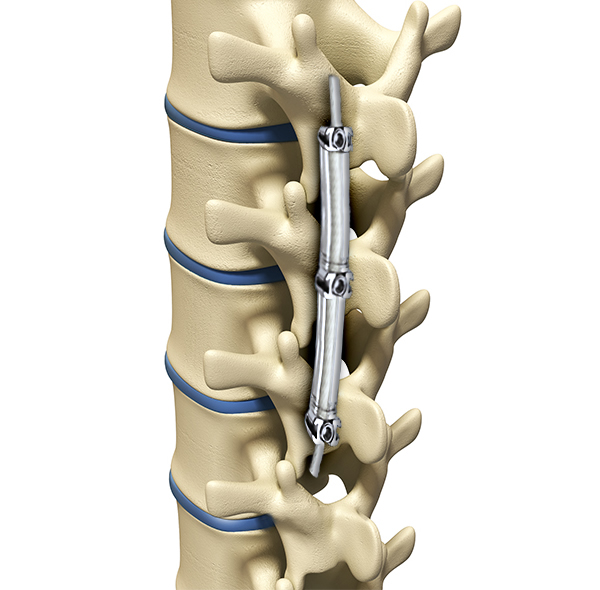
Spinal – or vertebral – fixation is an orthopedic surgery fusing vertebrae together to heal as a solid bone. This restores stability to the spine and helps eliminate pain caused by motion.
This procedure is particularly helpful in treating spinal disorders causing movement to be painful. The disorders include:
- Spinal stenosis
- Spinal tumors
- Spinal infections
- Herniated disc
- Degenerative disc disease
- Scoliosis, or curvature of the spine
- Fractured vertebrae which might be making the spinal column unstable
- Kyphosis, or the abnormal rounding of the upper spine
- Spondylolisthesis, a condition where one vertebra slips onto the vertebra below it causing immense pain
- Spinal instability or weakness due to arthritis or infections
Procedure For Spinal Fixation
A spinal fusion procedure may involve a discectomy which is the removal of a disc due to disease or damage. In the remaining empty space, bone grafts are placed to maintain the correct height between bones. When this is performed in the cervical spine in conjunction with a discectomy, then it is called a cervical fusion.
There are several techniques that may be used to fuse the spine as well as different approaches that can be used to reach your spine.
THE ANTERIOR APPROACH: when the spine is approached from the front. This requires an incision in the lower abdomen for a spinal fusion or in the neck front for a cervical fusion.
THE POSTERIOR APPROACH: incision is made from the back. The spinal fixation procedure is performed as follows and under general anesthesia.
BONE GRAFTING: when small pieces of bones are placed into the space between the vertebrae to be fused. This will cause bone to grow as it heals, increasing bone production.
IMMOBILIZATION: uses screws, plates and rods to hold the spine still in to fixate it into one position. This increases the rate of successful healing following a bone graft.
The right procedure for a patient will depend on the nature and location of the disease in question.
Post Operation
It is likely that a patient will need a short hospital stay of about three to four days for observation post-operation. Pain medication will be prescribed as well as instructions for new ways to move as the mobility will be limited. Patients may also need a brace for proper realignment of the spine. Full recovery may take about three to six months.
Why Bonex?
At Bonex Klinik, innovative treatment plans are designed specific to cervical spine and neck treatment that addresses the source of pain. Our expert team of clinic staff is able to successfully explore which options of treatment are best for you after a thorough assessment. Using top-tier technology, Bonex Klinik doctors are able to address the source of pain and create a simple to understand patient care plan getting you back to life as soon as possible. We recognize that in seeking treatment you have many options. You will find an excellent team of healthcare professionals at Bonex Klinik with a specific collaborative planning team that will help you achieve the pain free outcomes you desire.
From diagnosis to discharge, spine treatment is developed by your highly trained team of specialists specific to what you require.

